22nd October 2025
- Blog
Last updated: October 2025
Short answer: Scaling a stop-motion art department & puppet fabrication for feature film requires shifting from a craft-first mindset to an industrialised system of mass fabrication, rigorous quality control, and proactive supply-chain management, led by experienced production leadership.
“A showreel shows you the finish line,” notes our Senior Producer Ollie Perrin. “But for a producer, the real question is about the race itself. Can your partner keep a relentless pace of asset creation without stumbling? That’s where productions live or die.”
Any skilled artisan can hand-craft one perfect puppet. A feature film needs hundreds, consistent silhouettes, predictable performance, and bulletproof durability, delivered on schedule and on a budget. This article reveals the system we use to achieve that scale and certainty, so producers and executives can assess feasibility with eyes wide open. Read on to see how we turn beautiful custom puppets into a reliable, repeatable production process suited to the marathon of long-form storytelling.
Our Blueprint for Scale: The Four Pillars of the A+C Art Department
Our long-form operating model rests on four mutually reinforcing pillars:
- The Production Line – turning maquettes into mass-fabricated puppets
- The Digital Backbone – real-time asset tracking and a multi-stage QC pipeline
- The Supply Chain – resilient materials sourcing and inventory control
- The Leadership – an experienced Head of Workshop who absorbs pressure and unlocks solutions
Together, they compress schedule risk, stabilise quality, and create transparency for producers.
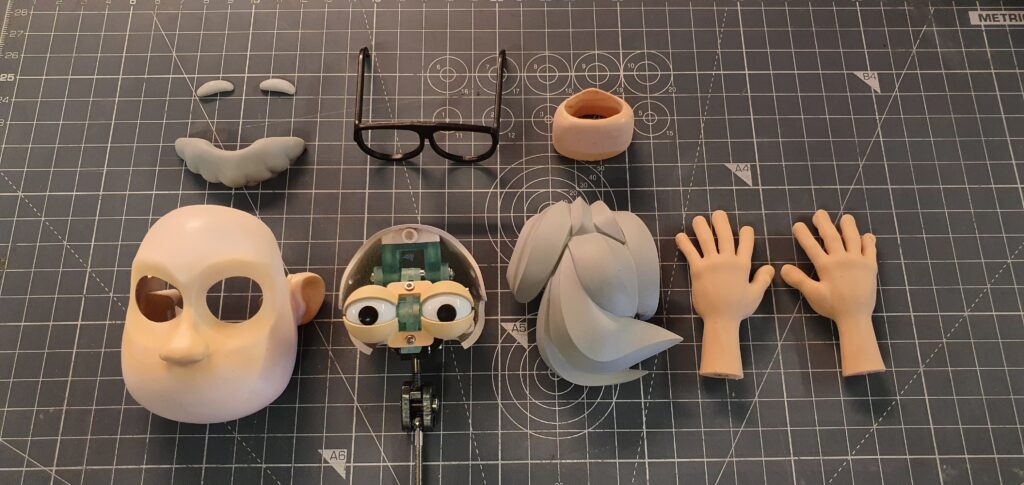
Pillar 1 – The Production Line: From Maquette to Mass Fabrication
When you scale from one hero puppet to two hundred screen-ready units, the challenge shifts from “how! to craft, to “how many” at pace, without drift. We design a manufacturing-grade workflow where artistry and process co-exist:
1) Hero Maquette & Digital Scan
We begin with a hero maquette sculpted to the director’s approved character design. Once signed off, we perform a high-resolution digital scan to lock the model’s silhouette, proportions, and micro-details. That scan becomes our geometric truth, the reference that prevents accumulated error across hundred’s of builds.
2) Modular Mould Making
From the scan, we engineer modular moulds that allow interchangeable sub-components (heads, hands, costume elements) to be cast in parallel. The goal is to separate time-consuming tasks into concurrent tracks, it saves time and creates a cleaner path to consistent frame-by-frame performance.
3) Materials & Casting
We specify materials by performance requirement:
- Platinum-cure silicone for faces and high-flex zones where repeat deformation must not tear or gloss under lights.
- Foam latex or specialist foams for lightweight volume where elasticity and paint adhesion are key.
Each material is documented with curing profiles, mix ratios, and environmental tolerances to ensure repeatability across production phases.
5) Assembly & Seaming
Specialist teams tackle assembly cells: armature fit-up, seam finishing, eye-mechanism alignment, and mouth-swap registration. We standardise jigs and fixtures so every unit lands within tight tolerances, ensuring identical silhouettes across batches.
6) Finishing, Paint & Hair
Surfaces are primed, painted, and sealed using recipes captured in our digital pipeline, pigment mixes, spray passes, and varnish types are version-controlled. Hair or fur is applied with repeatable density counts and direction maps so two puppets read the same at any camera angle.
“Consistency is everything. When you’re making the 50th version of a background character, it needs the exact same durability and poseability as the first. Our modular moulding system and QC gates eliminate variation so every asset is hero-quality” – says are Lead Puppet Fabricator
Why it matters: This staged asset creation model allows multi-unit throughput, predictable cycle times, and scalable labour, perfect for long-form visual storytelling where production momentum is everything.
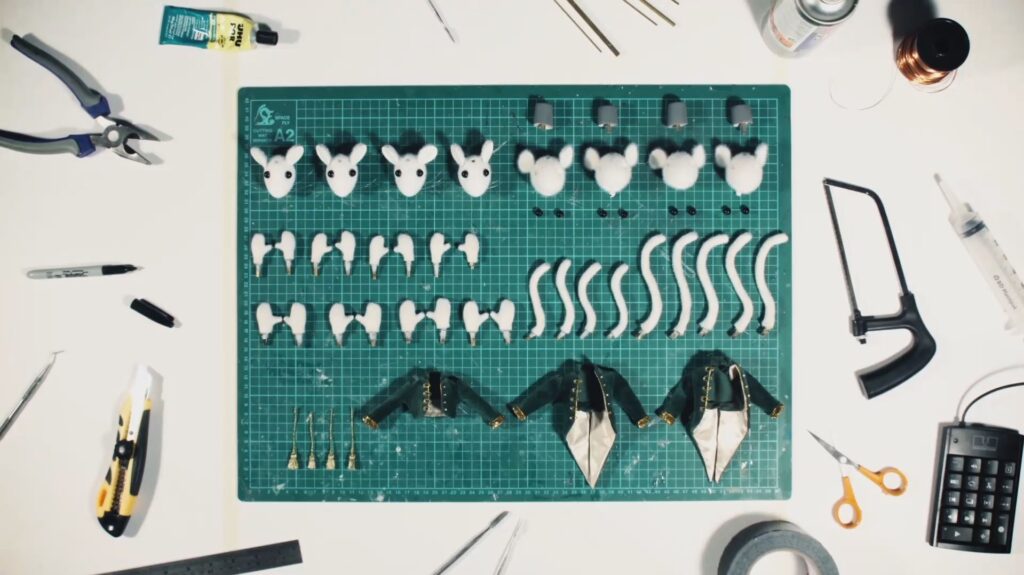
Pillar 2 – The Digital Backbone: Asset Tracking & Quality Control
If the production line is the muscle, the digital backbone is the nervous system. We maintain a real-time “digital twin” of every physical asset (from a puppet’s eyeball to a prop hinge) inside our project management stack, ShotGrid (or equivalent) integrated with our internal dashboards.
What we track for each asset:
- Unique ID and version number
- Assigned artist / team and current stage (e.g., “in Moulding,” “In Assemble,” “Paint Pass 1”)
- Due date, dependencies, and blocking issues
- QC feedback history with annotated photos or short clips
- approvals and release status to animation
Three-Stage QC Pipeline
- Dimensional & Structural QC (Gate A): We verify silhouette against scan (tolerance windows), check armature torque, joint smoothness, seam integrity.
- Finish QC (Gate B): Paint consistency (spectro-check or reference chips), sheen matching, hair direction, and costume fit, recorded with controlled-light photography for apple-to-apples comparisons.
- Performance QC (gate C): Quick real-time pose-tests, micro-posing, head tilt, eyelid movement, replacement mouth snap, captured as a short animation software test to validate on-screen behaviour before release to set.
Predictive Control & Reporting
- Throughput dashboards provide real-time burn-down views and highlight bottlenecks weeks before schedule impact.
- Exception reports flat assets failing Gate A/B/C more than once; root-cause tags (mould wear, material batch, operator variance) inform corrective actions.
- Line-producer views offer roll-ups by character family, episode, or shooting unit, no black boxes.
“Our tracking system isn’t a to-do list, it’s our central nervous system” says our Senior Producer. “It gives us a granular, live view of the entire inventory so we can reallocate resources before a small delay becomes a big problem on the animation floor.”
Why it matters: Producers gain total transparency into progress, quality, and risk. For the animation team, only stable, camera-ready assets hit the stage, keeping post production and reshoots under control.
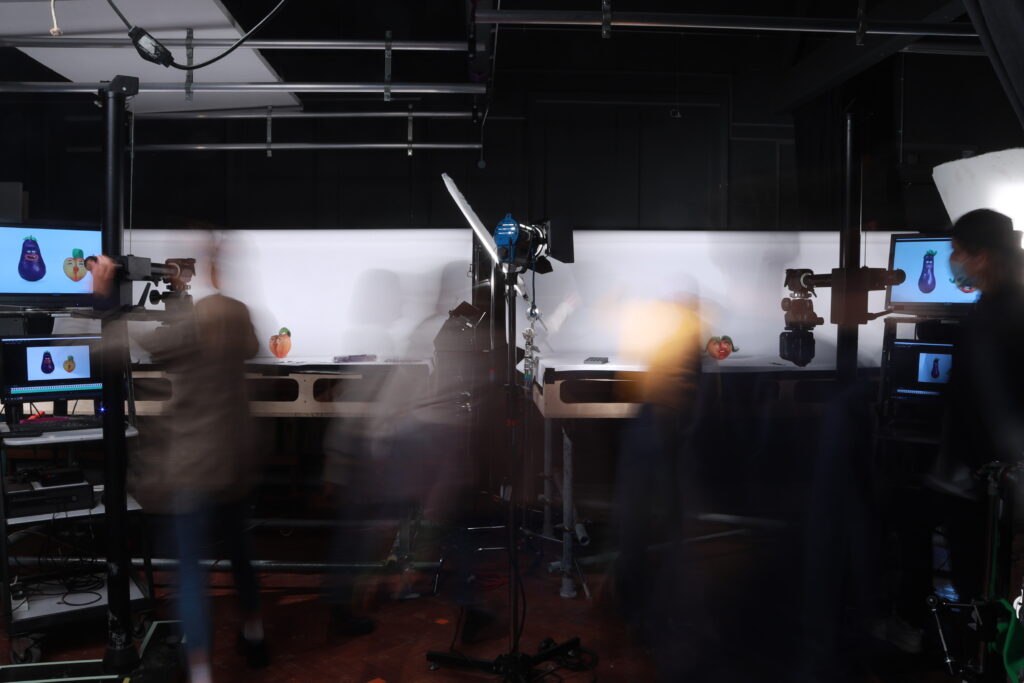
Pillar 3 – The Supply Chain: Sourcing Materials at Scale
A long-form production can be stopped dead by the smallest missing part. For us that “nail” might be a particular grade of silicone, a custom-milled ball-joint, or a specific foam that behaves correctly under heat and lights. We treat supply as a first-class production discipline.
Forecasting & Inventory
- We derive materials forecasts from the approved build matrix (counts by character, duplicates, spares).
- Safety stock levels are set by lead times and supplies reliability; high-risk items get dual-sourced.
- Batch tracking links each puppet to material lots, supporting traceability if a quality issue appears weeks later.
Approved Supplier Network
- Primary & secondary suppliers are pre-qualified for silicone systems, pigments, foams, and armature components.
- We maintain spec sheets & test swatches per supplier so changes are caught early (viscosity shifts, pigment strength, catalyst behaviour).
Receiving & Material QC
- Incoming materials are spot-tested: small test pours for curing integrity, adhesion tests on standard coupons, torque validation for mechanical parts.
- Any variance triggers containment (quarantine) and a supplier deviation report to prevent contaminated batches from entering the line.
Sustainability Considerations
- We plan for material reuse where feasible (e.g., jigs, fixtures, packing), and segregate off-cuts for recycling or responsible disposal, supporting both environmental targets and budget control.
“You can have the best artists in the world,” says our Studio Manager, “but if you run out of the right foam mid-production because a ship shipment slips, the show grinds to a halt. That’s why our supply chain has redundancy and contingency stock built in, just like any other mission-critical system.”
Why it matters: Forecasting, redundancy, and tight supplier relationships prevent cascading delays and give producers confidence that asset flow to set will not be interrupted.
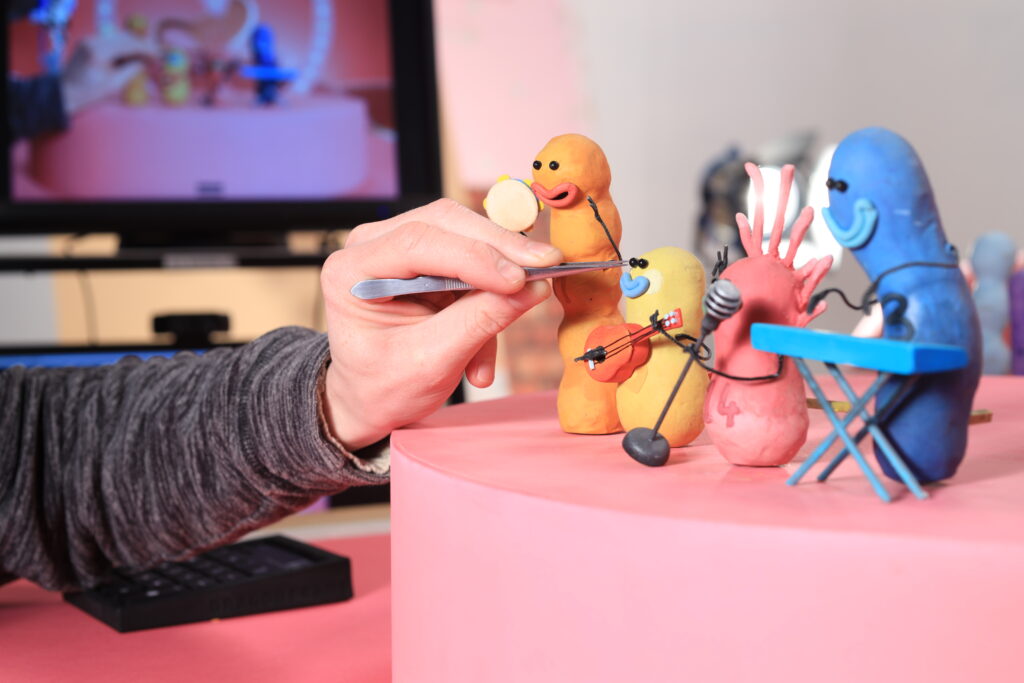
Pillar 4 – The Leadership: An Experienced Head of Workshop
Processes and dashboards only work if someone is reading the room, absorbing pressure, and making the right call at the right time. That’s the job of our Head of Workshop/
A short case study:
Mid-schedule, a key facial silicone batch started curing soft, leading to subtle paint sheen mismatch under key light. Our Head of Workshop halter Gate B releases, switched to alternate supplier stock already validated in our library, and green-lit a rapid re-paint protocol with an adjustment varnish stack to equalise sheen. Within 48 hours, batch stability returned, and the animation units stayed fed, no schedule slip.
“My job isn’t to ‘manage a room’, it’s to absorb pressure,” they say. “They director and producers need creative options, not logistical problems. Our systems and team exist to turn complexity into certainty.”
Why it matters: Long-form is a marathon. When issues inevitably surface, you want leadership that can anticipate, triage, and translate challenges into actionable solutions without breaking the schedule.
Built for the Marathon
Creative vision is essential, but it’s operational excellence that geta feature film to the finish line. Our production line ensures stable quality at speed. Out digital backbone gives producers real-time visibility. Our supply chain ensures material continuity. And our leadership ensures agility when the unexpected happens.
“Ultimately, our clients aren’t just buying puppets” says Dan Richards, Founder of A+C Studios. “They’re buying certainty, that their vision will be achieved at scale, on schedule, and to the highest standard. We’ve engineered out stop-motion asset creation workflow to make that certainty real.”
Discuss Your Long-Form Project
Producer’s Quick-Glance Checklist
- Asset Uniformity: silhouette tolerances + torque targets defined and monitored
- QC Discipline: three gates (structural, finish, performance) with photographic/video proof
- Digital Tracking: live dashboards, no black boxes; exception reporting
- Supply Resilience: dual suppliers for critical SKUs; safety stock; batch traceability
- Leadership: Head of Workshop empowered to pause/re-route without waiting for committee
Frequently Asked Questions
- Q1: How many duplicate puppets should I budget per hero character?
It depends on screen time, stunt requirements, and unit count, but we typically plan 3-6 duplicates per hero plus service spares (hands, heads, costumes). The final number follows the shot list and animation unit plan. - Q2: Can you maintain identical paint finishes across large batches?
Yes. We version-control pigment recipes, spray passes, and varnish stacks; spectro-checks and controlled-light photos ensure finish matching batch-to-batch. - Q3: What happens if a material spec changes mid-show?
Our alternate supplier library and incoming QC let us swap SKUs with minimal downtime. The Head of Workshop coordinates rapid re-qualification before Gate A re-opens. - Q4: How do you prevent armatures from loosening during long shoots?
Armatures are built to torque specs and serviced on a fixed interval. We provide on-set micro-service kits and track joint performance in our digital twin, enabling preventive maintenance. - Q5: Can this workflow adapt to episodic series or digital-first shorts?
Absolutely. The same pillars, production line, digital backbone, supply, leadership, scale down for shorter runs while maintaining predictability and speed across social media platform and OTT deliverables.